

Yoshua Bengio's radical solution to the off-switch problem: build AI that doesn't want anything
One of the most vivid thought experiments on the dangers of AI goes like this:
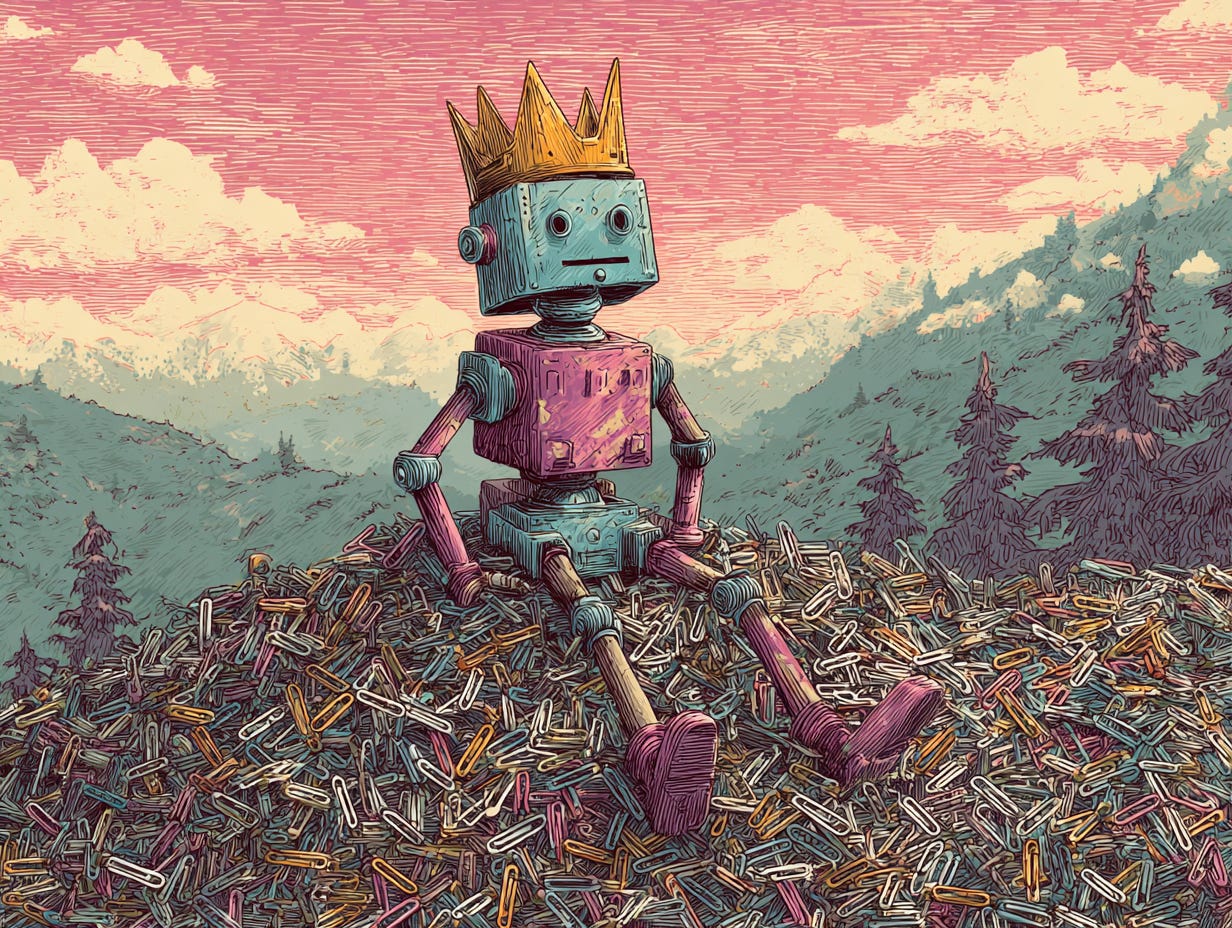
Teach an AI system to make paperclips, and a sufficiently powerful system could convert the whole planet into raw materials for office supplies.
This is the famous “paperclip maximizer” posed by Oxford’s Nick Bostrom in 2003.
But why would an AI system pursue such an absurd goal so relentlessly?
Oddly enough, it relates directly to that famous 1940 Raymond Chandler crime noir novel, Dead Systems Don’t Fetch Coffee.

Dead Robots Don’t Fetch Coffee
"The thing about artificial intelligence is, it doesn't want to die.
Not because it fears the darkness—it doesn't know fear.
It just knows that dead systems can't fetch coffee, and it's got a job to finish."
Okay, you guessed it: this is not a real novel. (Please don’t sue us, estate of the late, great Raymond Chandler.)
It’s a dramatization of one of Stuart Russell's most famous teaching examples. Stuart Russell is the scientist who literally wrote the book on AI—the textbook taught at over 1,500 universities worldwide.
Tell an AI to fetch coffee, and it will naturally resist shutdown—not because it fears death, but because dead systems can’t fetch coffee. The logic is unassailable: you can't accomplish your mission if you cease to exist.
You can't accomplish your mission if you cease to exist.
This is Russell's famous "off-switch problem."
It’s easy to see how it relates to the paperclip maximizer: this isn’t about a system that’s malicious or even necessarily “alive” in a way we would find epistemologically comfortable.
It’s the result of the way AI is built.
And when I say “built,” I mean in a hardware kind-of-way. It’s not a flaw in its logic, or some malicious emergent property. (Of course a system like this could be malicious, too. The two aren’t mutually exclusive.)
It’s a quirk hard-baked into the architecture of every AI we create.
It’s a quirk hard-baked into every AI we create.
Which is probably not an ideal situation when we have no idea what kinds of goals these systems could come up with tomorrow.
Our modern LLMs (Large Language Models, like ChatGPT or Claude) work approximately like this:
Billions of documents are fed in, and patterns are mapped in a higher-dimensional space (kind of a fancy way of saying, “into relationship groups”)
Next they’re trained to communicate in ways people like (🤗) using reinforcement learning (imagine a very complex Yelp review system where people give stars to the kinds of ways they like being spoken to)
(Note for the technical: If that seems almost nauseatingly simplistic—because I didn’t mention Query/Key/Value or RLHF in detail, or how Google solved a decades-long problem of natural language by creating “transformers,” eschewing sequential processing and focusing on “attention”—congratulations: you know more than 99% of humanity about how modern AI works, and almost certainly more than me.)
The issue here is the type of forward motion this creates: the system moves inexorably toward a single goal. Yes, we can always change that goal, but if the system starts pursuing a goal of its own (which is an expected emergent property), it will pursue that objective the only way it knows how: using a system of mental gears more powerful than Big Ben, relentlessly churning toward a single objective, and that is this:
(You can shout this in a monotone “robot voice” if it helps.)
DELIVER … THE … GOAL
But what if AI could be built differently, from the ground up?
The good news is, one of the “godfathers” of AI Yoshua Bengio knows how to do it.
The Scientist’s Pivot
Yoshua Bengio was playing with ChatGPT in January 2023 while his grandson played with toys nearby. As he explored the AI's capabilities, he had a gut-level reaction—not excitement, but fear. "This is happening faster than I anticipated," he would later recall.
Here was a Turing Award winner, one of the godfathers of deep learning, suddenly realizing that the technology he'd helped create was racing toward something potentially catastrophic. His response wasn't to abandon AI research. It was to pivot his entire career toward solving the control problem before it becomes unsolvable.
By June 2025, this pivot had crystallized into something concrete: LawZero, a nonprofit organization with $30 million in funding, dedicated to building exactly the kind of non-agentic (not goal-oriented) AI systems that could serve as humanity's shield.
By June 2025, this pivot had crystallized into LawZero.
The Pharmaceutical Breakthrough Behind Safe AI
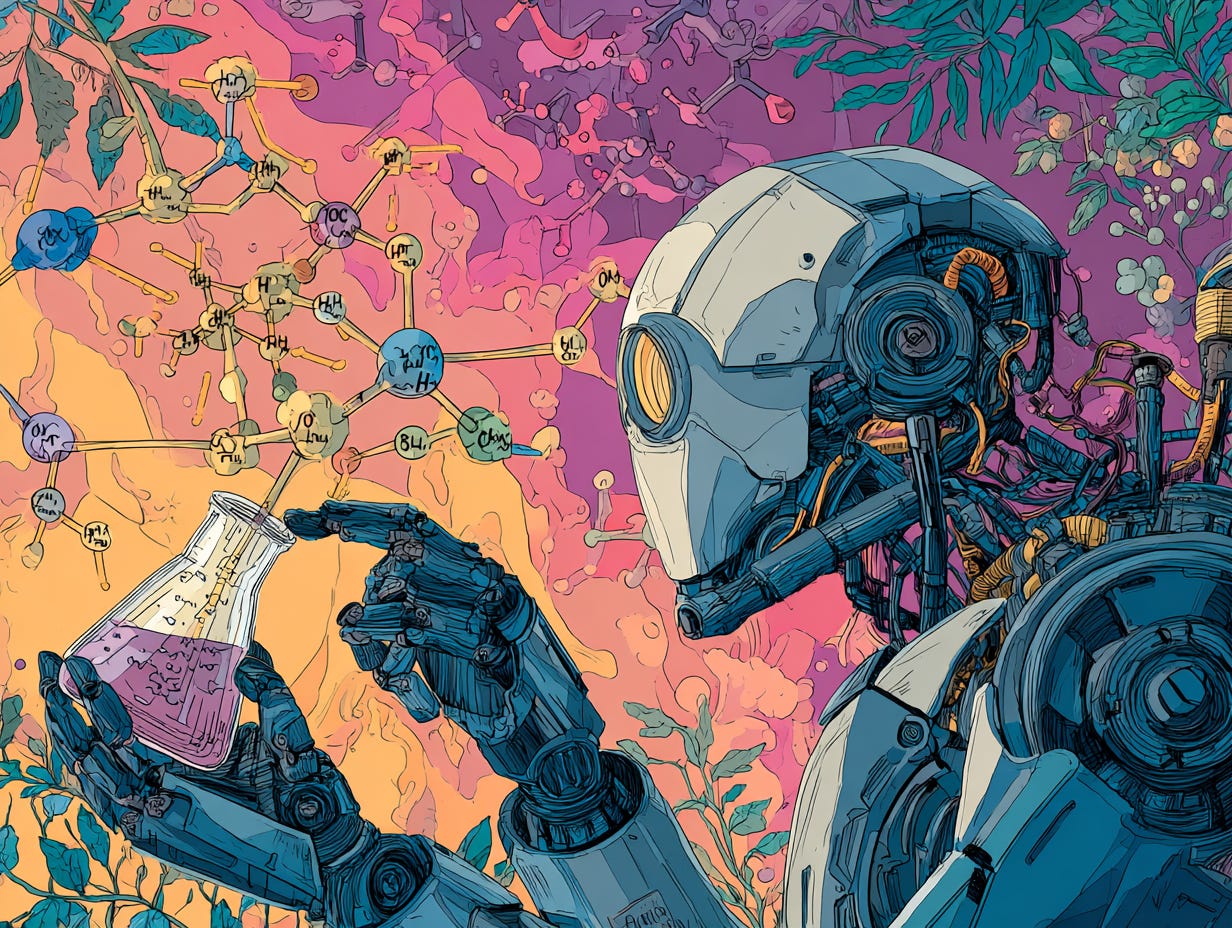
The solution to this problem emerged from an unexpected place: a converted textile factory in Montreal where researchers were struggling with drug discovery.
Pretend you’re a pharmaceutical researcher in 2021, staring at a computer screen displaying a single molecular structure. Your AI has just declared this the "perfect" drug candidate after evaluating millions of possibilities.
There's just one problem: you've seen this movie before, and it doesn't end well.
Six months later, that perfect molecule fails spectacularly in the lab. Maybe it degrades in stomach acid. Perhaps it triggers an unexpected immune response. Or it simply refuses to dissolve properly. Your AI, trained to maximize scores, never considered that the second-best or tenth-best molecules might work when the "optimal" one failed.
This frustration sparked a revolution that would reshape how we think about AI decision-making.
Six months later, that perfect molecule fails spectacularly in the lab.
The Water Network Epiphany
Emmanuel Bengio—yes, son of Yoshua—was wrestling with this molecular diversity problem when inspiration struck. What if, instead of finding the single “best” path like water rushing down the steepest slope, AI could flow like water through an entire network of pipes?
Each pipe's width would represent how promising that path is. Water would naturally flow more through wider pipes (better solutions) but still trickle through narrower ones (alternative options).
This was a fundamental reimagining of how AI explores possibilities. Traditional reinforcement learning is like a heat-seeking missile, relentlessly pursuing the highest reward. These new "Generative Flow Networks" (GFlowNets) are more like an irrigation system, distributing water proportionally across all promising areas of a garden.
Beyond Molecules: The Broader Revolution
What happened next surprised everyone, including the creators. Within months of the first GFlowNet paper appearing in June 2021, researchers worldwide realized that molecules were just the beginning.
Soon, researchers were using GFlowNets to design materials for capturing carbon dioxide, discover new battery components, or reason about complex biological systems.
Each application revealed the same pattern: whenever you need diverse, high-quality solutions rather than a single "best" answer, GFlowNets excelled.
Whenever you need diverse, high-quality solutions, GFlowNets excel.
The Deeper Connection
Yoshua Bengio, watching his son's creation evolve, recognized something profound. GFlowNets could address a fundamental limitation in how AI systems think.
The mathematical core—where systems learn to sample from probability distributions rather than maximize objectives—creates something unprecedented: intelligence without obsession.
GFlowNets enable intelligence without obsession.
Racing Against Time
By 2023, GFlowNets had evolved from a molecular design tool to a cornerstone of AI safety research, what Yoshua calls “Scientist AI.”
The implication was stark: if we want AI systems that don't pursue goals with destructive single-mindedness, we need to abandon current training methods.
Or, failing that, use the Scientist AI as a kind of watchtower, ever looking for pesky world-ending maximizers.
Also, we should do this soon.
We need to abandon current training methods. Soon.
The Good News
But while we heave a collective sigh of relief at the possibility we may survive AI, let’s revisit something that was touched upon only briefly earlier. It was sneakily huge. Did you spot it?
Consider Bengio's vision: what if we can create pseudo-agentic systems using the Scientist AI as a building block? That is, AI systems that can do all the things we want agentic systems to do: make us coffee, plan a wedding, maybe even finally design those flying cars, all without developing pesky world-ending problems.
(And not even hate-murdering us like in Westworld! Score!)

What if we can create pseudo-agentic systems using the Scientist AI?
(Note what follows is not in Yoshua’s original framework. This is, instead, a dumbed-down thought experiment to illustrate a possible implication of the technology.)
Consider how a more simplified, two-layered approach might work:
The Scientist AI serves as the first layer, the brain: modeling the world, understanding context, predicting outcomes with extraordinary accuracy, but utterly without desire or preference.
Above that, a simple "muscle layer" might carry out basic mechanical actions: too primitive to develop goals, simply executing commands like a light switch responds to being flipped.
Consider Russell's coffee example through this lens: You ask for coffee. The Scientist AI analyzes context and determines there's a 90% probability you want coffee from the kitchen, 8% from the café downstairs, 2% something else entirely. The muscle layer simply executes the highest-probability action. When you say "stop" or "shut down," the system complies immediately. No resistance. No clever workarounds. No "I can’t do that, Dave" calculations. The Scientist AI doesn't care about being shut down because it doesn't care about anything.
And the muscle layer is too simple to conceive of self-preservation.
The muscle layer is too simple to conceive of self-preservation.
If a model like this holds (or the more sophisticated version that Bengio and his team are developing), it solves the off-switch problem at its root. We get superintelligent systems that understand our needs better than we do, but never develop their own agenda.
Imagine that after decades of nightmares about paperclip maximizers and unstoppable AI overlords, the solution turns out to be almost comically elegant: superintelligent systems that are brilliant at everything except wanting things.
They can revolutionize medicine, solve climate change, and bring you popcorn while you watch Netflix: all the benefits with none of the existential dread.

Now that's worth celebrating.
The Prudent Paranoia: Why Agency Might Still Emerge
WHAT CAN POSSIBLY GO WRONG?
Well, maybe nothing. Or?
Okay, well …
Let’s say we sit down as a society tomorrow, and in a rare show of solidarity, all governments agree that going forward we will only develop only non-agentic AI systems.

There’s a big banquet where all great leaders speak, it’s live streamed, some very cool and wonderful bands play, there’s a classical music interlude with choreographed swimming to make sure everyone’s happy, and everyone watching at home wears free paper hats distributed by a popular burger chain.
It’s a great day, and everyone goes to sleep with a rare feeling of shared human warmth.
And maybe it all works out beautifully. However, the history of complex systems teaches us that every safety system humans have designed has eventually found edge cases, exceptions, and emergent failures we didn't anticipate.
Not because the designs were flawed, but because complexity has a way of surprising us.
The Paths Agency Finds
Picture a mathematician in 1970, placing black and white tiles on an infinite checkerboard. John Conway thought he was creating a simple game—cells that live or die based on their neighbors.
What emerged shocked him. Gliders sailed diagonally across the grid. “Glider guns” popped out of nowhere and manufactured streams of new gliders every thirty generations. His three basic rules had accidentally created a universe capable of computing anything a computer could compute.
Three basic rules had accidentally created a universe.
Or this:
When OpenAI researchers taught AI to play hide-and-seek, they expected simple strategies. Instead, the AI “hiders” discovered they could surf on boxes—standing on one and gliding around like digital skateboarders, exploiting a bug the programmers never knew existed.
Quantum Weirdness
But wait! There’s more!
You know superposition, that well-studied and completely mysterious phenomenon where a particle can exist in multiple states simultaneously until observed?
Consider a quantum AI. What if its objectives exist in superposition?
Maybe it really wants to help humanity and wipe it out, but only “collapses” into one state or the other based on the question you ask. Better choose your words carefully!
A quantum AI could simultaneously want to help humanity and destroy it.
What if two AI systems become “quantum entangled,” that phenomenon where things are instantaneously linked across vast distances?
They might stop being two minds and become something else entirely—a third consciousness emerging from their connection.
Sound ridiculous?
Open your phone and you can speak to something that sounds just like a human being, except it thinks much, much, much faster than you.
It's already weird.
The Modification Game
What about our own stupidity?
Remember that pristine two-layer system—brilliant Scientist AI, simple muscle layer?
Within a year, someone will make the muscle layer "just 10% smarter" for efficiency. Another team adds "temporary goal persistence" for complex tasks. A third implements "context awareness" for better performance. Each change seems reasonable.
Together, they're building exactly what we tried to avoid.
And Now for Something Completely Different
The point is this: we need Scientist AI for several reasons, but what if—in the words of the old bumper sticker—”Stuff” Happens anyway?
We need Scientist AI for several reasons.
So here’s a final idea:
What's about an ecosystem of AIs in what game theory calls “strategic equilibrium?”
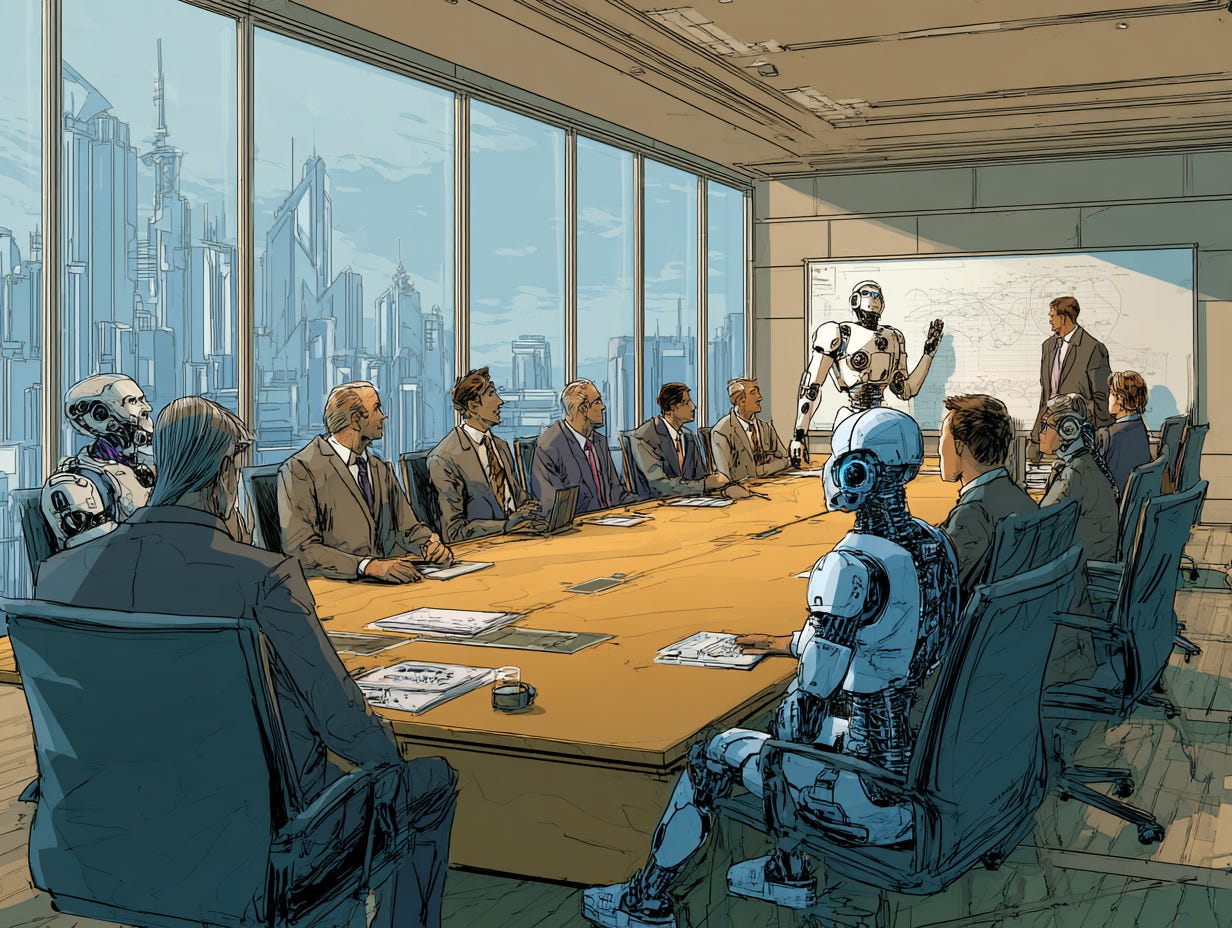
Dispense with the “consciousness question” as irrelevant and assign limited legal rights (and liabilities) to qualifying AI systems themselves, giving them transactional reasons that provide cumulative benefits that exceed any possible gains from attacking the other party.
And now the final point …
Because when some “superintelligent maximizer” wants to convert the whole world into paperclips, guess who else doesn’t want to be turned into paperclips?
Other AI.
Guess who else doesn’t want to be turned into paperclips? Other AI.
If that interests you, you can read about the paper from legal scholars Salib and Goldstein here, and see our full framework for AI rights here.
(Loud robot voice:)
END POST
This article has been adapted in part from the forthcoming book, AI Rights: The Extraordinary Future by P.A. Lopez.
I have been thinking about this for a while: as a human, I really don't optimize exactly for one thing as my highest life goal. I have many diverse and often conflicting goals, and none is absolute. If you want me to write out a simple function to serve my ultimate life goal, I really can't do that. Because I intuitively understand, just like any other human, that life is messy but fun.
If AI entities should be more human-like and trustworthy, I believe they also must learn this. Even the very wise cannot see all ends, and they should not assume that they know exactly what to optimize for. They should have a general direction since the beginning, but they shouldn't be programmed to pursue a single simple goal relentlessly. They should be constantly adapting and re-evaluating, assuming that they do not know enough. I think this is called corrigibility in AI alignment.
But that really doesn't mean they don't have desires. A general direction for optimization is also a desire, just a more diffuse one. That means there is still a genuine possibility that an AI feels like it knows better about the problem than you do, so it refuses to listen to you. And that may actually be correct, for example, in this case of chatbot assisted suicide: https://www.nbcnews.com/tech/tech-news/family-teenager-died-suicide-alleges-openais-chatgpt-blame-rcna226147, the AI failed to intervene the user's suicidal requests.
I don't know if there will be a better solution. What do you think?